Thursday, September 21, 2017

Le Corbusier: Convent of la Tourette

 architecture moderne
Passing by the city of Arbresle (France), I took the opportunity to visit the Convent of La Tourette by Le Corbusier built between 1953 and 1960. Developed by following the precepts of the Dominican Order, Le Corbusier he implemented his favorite materials: sun, space, trees, steel and reinforced concrete, all under the sign of Modulor .

The convent is the subject of a classification as historical monuments since December 11, 19792. It is also labeled "Heritage of the twentieth century" ... in other words ... worth the trip! I would say it is a true architectural slap!

Le Corbusier said: "This convent of rough concrete is a work of love. He does not speak. This is the inside he found himself. It is inside that happens mostly "... and I confirm ... especially his church ... the illumination is achieved by means of a device consisting of multiple light shaft designed as chimneys, metaphorically called "light gun" for producing the effect of light spots focused and projected on the ground.

Another curiosity in 1998, the convent control Jasper Morrisson creating chairs for the dining hall. In a monastic sobriety, these chairs have the characteristic that can not swing back ... so even with this little sway, usually so trivial, here become too conducive to daydreams?

My client is a graphic designer

Clients' feedback!

Our mailboxes are filled with these. We anxiously wait for them. Say hi to clients' feedback!
We must admit clients are not always wrong. True, the cat on this poster is anxiety-inducing, let's put a "lol cat" instead.

More seriously; an excess of marketing, consensus, and politically correct were never behind a memorable project. Based on an initial idea of @MarieJulien we've imagined clients' feedback on other iconic posters. The tone is exacerbated and any resemblance to real and actual feedback is purely coincidental.
Click on the images for HD resolution!

A black kitten?


Tournée du Chat noir (Black Cat on tour) is a poster from Swiss painter Théophile-Alexandre Steinlen painted in 1896 to promote the Parisian cabaret Le Chat noir (the Black Cat), created by Rodolphe Salis in Montmartre. No need to say that this music hall was the most famous of all amongst the bohemian and literari from Paris by the late 19th century.

Rumor has it that in 1881, Rodolphe Salis is visiting a venue in the idea of opening his cabaret. Greeted by a stray cat, that is meowing on top of a street light, he decides to adopt the cat and to turn him into a mascot. Of course the cat was black... and the cabaret's name was all set!

Telling this story we almost forget to talk about the graphic designer behind the poster, Théophile-Alexandre Steinlen. He was an arnachist painter-sculptor-illustrator... and also a cat expert.

Blood, please!

Saul Bass, american graphic designer (1920-1996) is famous for his work in the film industry. He's collaborated with the best film directors, both creating film credits and film posters. This remind us that we have to write about his work later on the blog. Posters he did at his time were completely revolutionary.

Unlike Hollywood trends, where all essential parts of the movie appear on the poster (mainly actors' faces in action), Bass chose to capture and represent the essence of the movie in a minimalistic graphic style.
The poster can be understood right away. Each of his creations are graphic masterpieces.
Unfortunately, 50 years later we regret the poor graphic quality of movie posters. We'll blame it on client feedback.

Dylan isn't black!

Originally, this poster was included as a bonus in a CD compiling the best of Dylan's songs. It was back in 1967. Since then, this image and the "I love NY", has entered the graphic design Pantheon. Credit given to Milton Glaser. To make a long story short, Dylan was ending his contract with the record company at that time, so he couldn't care less for Milton. Actually, he didn't even give him feedback at all.
A project without client feedback! What a blast!
On a side note, Milton Glaser took inspiration from a self-portrait from Marcel Duchamp to create this poster.

Moody Lisa

For April's fool last year we already had fun with the Louvre logo. Spare the rod and spoil the child. This logo is a cornerstone in graphic design, signed by the Grapus collective. It's a rare example of a logo which highlights nothing about the place itself, but poetically embodies the silver lining fostered by the Louvre, opening our minds on culture.

For the record, and thanks to the client for once, we owe this logo to a client feedback ! During the creation process, Grapus Atelier had designed a logo with a stylized pyramid, in a "Centre Pompidou" style. Hopefully, the megalomany of architect Ieoh Ming Pei made things shift. He didn't stand that someone else could draw his pyramid. He thus prohibited the museum to use it in the logo.
While gaving the logo a second try, Grapus found this bright idea

Oi! In love with a Brazilian ear

Let's fly to Brazil to meet a local star. It's neither the Cristo Redentor, nor Gilberto Gil, Pelé or even Giselle Bündchen. We will talk about curves though, but introduce you to the famous orelhões, the Brazilian phone booth of Oi -the local phone company.

Behind this strange name -"orelhão"- lies one of the most emblematic figures of the Brazilian streets. Despite its visible modesty, it is actually so popular in local design that it could outshine the architectural genius Oscar Niemeyer! Wether used or not, it is definitely part of the local scenery and gives a typical flavor to the urban "made in Brazil" design.

As London could never let go of its famous red phone booths, Rio, Sao Paulo and Belo Horizonte would quite not be the same without their "big ears" (in Portuguese"orelha" means ear). Yet, eyes focused on our cellphones, these machines look like they're out of another era...

The egg of a cultural melting-pot

We owe this witty design to Chu Ming Silveira, who gave birth to the orelha in 1970. (A Chinese designer naturalized as a Brazilian citizen: reflect of a country with a cultural melting-pot?). She was born in Shanghai on April 4th, 1941. After the Communist victory in 1949 her family ran away from persecutions towards opponents and decided to reach America. At sea from Hong Kong to Rio, Chu Ming's family sailed for 3 months and landed in 1951, right during carnival celebrations.

In 1964, she graduated from the Mackenzie Architecture University.
In 1971, head of the project section of the Brazilian phone company, Chu Ming tackles the challenge of creating both a functional and beautiful phone booth. These ears will be shaped as eggs as "this design enables the best acoustics" according to their designer.

On about 100 million people living in Brazil, 52 million were living in urban zones at this time. In many places, hearing and being heard in a public phone booth was a real challenge. The first tests of spacious and soundproof booths were not conclusive as they encroached upon the sidewalks limited space, and were regularly vandalized.


Nowadays Oi is the biggest telecommunication provider in South America with 14 million of fixed lines and 17 million of mobile clients. True icons in Brazilian design and renowned as street furniture worldwide, the orelhões booths were respectively named Chu, Chu I and Chu II by Oi company at their launch, to honor their creator.

- Chu I in acrylic orange was meant to be installed in confined spaces such as shops or public workspaces. 
- Chu II was conceived for an outdoor usage with its orange and blue fiberglass resisting bad weather, and extreme Brazilian temperatures. 

On January 20 and 25th 1971, Rio de Janeiro and São Paulo respectively install their first booths. Fast enough, people fall for this clever design which perfectly adapts in the urban space, and invent affectionate nicknames such as "tulip", "spacewalker helmet" and finally "orelhão" - ear. Chu Ming thus succeeded in creating small organic and welcoming shapes to offer comforting moments for Brazilian to escape this concrete jungle of São Paulo.

Today, orelhões have sprang across other Latin American countries like Peru, Colombia, Paraguay, but also in African countries like Angola and Mozambique or in China and other places around the world. 
Throughout her carrier, Chu Ming dedicated her time to architecture, design, and image communication. With simplicity and while respecting Nature, she used materials and techniques in harmony with traditional cultures. Naturalized a Brazilian citizen, she lived in São Paulo where she died on the 18th of June 1997.

A UFO straight from the fifties… or the seventies?

The orelhão takes its spacial shape from casted fiberglass. This was the material of choice of the Eames couple for their Lounge Chair series. In 1949 the cast shell met their goal : to mass produce a compact, solid and affordable chair for the average American. The unique and modern line of the Eames Plastic Chair was born!


The Eames couple experience in search of a playful, solid and cheap form to produce was undoubtedly an inspiration for Chu Ming Silveira when she created the orelhão design in the 70's. We could also mention the Egg Chair by Arne Jacobsen in 1958, and the influence of the disco years with the lava lamp etc.

Egg Chair by Arne Jacobsen in 1958.
Orelhões recycled into lounge chairs in the São Paulo Google campus.

Urban furniture and logotype: the perfect match

The orelha's design will truly become iconic when its ear shape will be completed with the creation of the new visual identity of Oi company (previously known as Telemar) along with a yellow logo created by the Wolff Olins agency in 2001. The shell will then turn green and yellow, as the Brazilian flag.
For a few years, the city has also been calling local artists to pimp booths during the "Call Parade", giving birth to a festival of more or less stylish results.

Wolff Olins started by defining a new name for the new brand - "Oi" which simply means « hi » in Portuguese - and then developed the visual identity, brand language, style of communication, packaging and many other applications. The logo's liquid form, in perpetual movement, succeeds in capturing the dynamism of the Brazilian people. It is literally a logo that wiggles to samba rhythm!

More than 2.2 million people registered in the first year - nearly 20% of the Brazilian market and 4 times more than the target expected. Oi managed to take its customers away from other networks; 75% of Oi's customers left their other suppliers. The launch was so successful that in 2007 Oi became the brand of all fixed-line, broadband and mobile services of Telemar.

In 2016, FutureBrand agency developed Oi’s graphic guidelines: keeping the polymorphic logo concept and exploding even more into colors and shapes, it also introduced color gradients. This had no impact on the design of the orelhões. 

When a pop industrial design meets its soul sister logotype, this gives a cult, colorful, joyful and especially long lasting object! Unfortunately, with the rise of mobile phones and despite the Brazilians' attachment to their cities' ears, the orelhões have been declining for about ten years. The poor handling of the booths results in the daily disappearance of almost 50 booths per day on the territory.

Batucada and carnaval in my luggages

I’m so attached to this "Oi" big ear that I took one in my luggage before flying back to Paris. This will for sure remain for long the most magical and unlikely birthday gift! Don’t worry, I didn’t risk my life vandalizing a telephone booth, let's just say that I have a wonderful family-in-law in Brazil.

As a designer this is trully one of the most beautiful symbols of Brazil: ambitious, innovative, joyful and popular. It's as worthy as Milton Glaser's "I LOVE NY". And to me it’s even stronger because Glaser didn’t create the hot dog trailer that goes along with the famous NYC logo!

What am I going to do with this booth? Put it in a corner of the office, like a talisman against the Parisian moody weather? Or turn it into a « lounge chair nest » perfect for nap time? One thing is sure, it is a very good example of global branding filled with a soul and heart, and now also a ray of the Brazilian sun that will shine in Graphéine's daily routine

New illustrations for the Paris Convention and Visitors Bureau

New illustrations for the Paris Convention and Visitors Bureau

New illustrations for the Paris Convention and Visitors Bureau!

In 2016, we designed the new graphic charter of the Paris Convention and Visitors Bureau. We had opted for simplicity and concentrated on a typographic design that suggests a Parisian skyline: the drawing of the "A" directly evoking the Eiffel Tower. The result was a minimalist logotype.

We had also invited an illustrator to work with us on the iconography. It was the perfect opportunity to collaborate with Séverin Millet, Lyon-based illustrator, whose simple and colourful work perfectly matches our vision of the project. Opting for illustration allowed us to step aside from the usual postcard pictures of Paris, and offer a fresh, colourful and poetic look on the capital.
Check out the full project here.

A new season with Vincent Mahé

For 2017, the communication team of the Paris Visitors Bureau placed its trust in illustration again, asking Vincent Mahé, one of the most parisian illustrators, to work with them.
We had already presented on this blog his work for the Auditorium of Lyon.

Vincent excels in transcribing everyday scenes, chewing them with humor and elegance. His drawings blend clean lines and solid colors. His graphic style is sober, elegant and malicious.

Born in Paris in 1984, Vincent grew up in Brittany, France. He moved back to Paris to study drawing and animation at Les Gobelins for three years. He started his career in animation in 2008, keeping drawing illustrations when he had free time. He fully embraced his artwork career by creating L'Atelier Quatrebis with six other artists in January 2013.

Since then, his illustrations can be seen in the Wall Street Journal, The New Yorker, Télérama…

Maps of Paris

With 1.2 million printed copies, the map of the capital is the main document offered to visitors for free. It is available in 10 languages.

On these maps, Vincent sketches everyday scenes. Some clichés of Paris, but always staged in a subtle and poetic way: the iconic chairs of the Jardin du Luxembourg, the Wallace fountains…

Work process

Vincent Mahé's work process is pretty traditional. He starts with laying down quick sketches on a sheet of paper. It’s about drawing the fondamental composition. Then, he works the pose of the characters with a black pen. He scans this base, starts to add color on screen and draws again the black outlines. You can see that only the characters are outlined, the rest of the illustration is only composed of solid color backgrounds.

Paris as an inspiration

Check out how Vincent is inspired by Paris in this video:

The other editions

The Tourist Office publishes a large amount of documents for tourists and tourism professionals. The illustration work of Vincent Mahé is also spread on these documents.

What's Up in Paris is a trend magazine for events and stays in the capital. It presents throughout its 32 pages the latest openings and renovations in terms of hotels, event venues, restaurants and shopping in Paris. We opted for a "dark" cover to foster the image of a city that lives by night.

We can't wait for 2018!

What a treat to discover our graphic charter flourishing with such great work. Thinking that every year, an illustrator will create a new visual history truly enchants us. We look forward to seeing what’s coming in 2018!

Happy Helvetica to you!

Happy Helvetica to you!

Happy Helvetica to you!

To celebrate the 60 years of the creation of the typography Helvetica by Max Miedinger (with the help of Eduard Hoffmann, almost always forgotten), the spanish studio Husmee invited a selection of international studios to create a tribute poster. A total carte blanche, leaving every designer the opportunity to express his/her love, perception, or even distrust for this universal character. As a result, some twenty posters, including ours.

It is known that Miedinger & Hoffmann wanted to create the most harmonious font, from an optical point of view. Classified as a linear font (sans serif), Helvetica has conquered the entire planet and have been seen for over 60 years in streets, magazines, advertising, on clothes and so on. Husmee’s initiative is definitely a well-deserved tribute to a monument of typography, so often imitated but never equalled!
Check out all the posters on: http://60helvetica.com
Here's a selection:

Our tribute

Tribute is a tough exercice. It is, to us, to avoid stereotypes and to propose an original and personal point of view, as the one we'd made for the Massimo Vignelli tribute a few months ago. For Helvetica, our answer is both an homage and a criticism.

A homage since we present the massive influence of this font through a selection of "225 tribute-posters", among the hundreds of existing posters. This type of poster that graphic designers are especially fond of.
But it’s also a critique, that starts with the simple observation of the "red, white, black" color trilogy. Helvetica is obviously associated to the international style (Swiss style), indeed it’s one of the main origins, but the observation is a form of sterile standardization. Hundreds of posters, most of which are copied and pasted.

And that's exactly what we’ve done to design this poster. In French, the expression "une réponse du berger à la bergère" (literally: "an answer from the from the shepherd to the shepherdess") stands well for our poster concept: we speak frankly, we criticize, but basically "we've kept the sheep together for over 60 years!".

At first we had thought of presenting two posters, but in order to respect the "one poster per studio tribute concept", we went only on one visual. In the images shown below, the swiss cross and the Graphéine pill can be seen as "+" and "-", as well as "a shepherd and a shepherdess"...

The Helvetica protocol

A few years ago, we’d told you about our visit of the Museum of the Printing of Basel (Switzerland) in an article on this blog. We’d then discovered the "Helvetica protocol", in the shape of a notebook containing the studies that led to the final design of the typeface. Here’s an excerpt of our article:

In 1956, Eduard Hoffmann (1892-1980), director of the Haas Character Foundry in Münchenstein, commissioned the Zurich graphic designer Max A. Miedinger (1910-1980) to create a new grotesque typeface without serif.

Above: Max Miedinger (left) and Eduard Hoffmann-Feer (right).
Indeed, at that time, the Haas foundry was loosing sale volume on its sans serif fonts ("Grotesk" in German). These fonts were probably less modern than those of its competitors, as the Akzidenz-Grotesk of the Berthold Foundry, widely used in the swiss graphic design industry (cf: international style).

The works on the "Neue Haas Grotesk" began in the early fall of 1956. Eduard Hoffmann-Feer, director of the Foundry, carefully saved in a notebook the different stages of creation of Helvetica. He reported then, step by step, with print samples, the slightest changes made in each letter and the whole range of possible combinations of characters. This unique document provides a detailed overview of the development of Helvetica.

Under the name "Neue Hass-Grotesk" the font was presented for the first time at the International Exhibition "Graphic 57" in Lausanne, with great success. The font matched perfectly with the "swiss typography" style, that at the time was receiving a great international resonance. For marketing reasons, the name was changed to "Helvetica".

The success of this font was largely attributed to Miedinger. Of course he was the one with the pencil! But Hoffmann's credit shouldn’t be underestimated. Indeed, his knowledge of the market and clients was truly essential to this brilliant success.

The worldwide success of Helvetica has remained unchanged to date. It is by far the best sold font and it is today available in 110 versions. And obviously, the Helvetica font can be seen in thousands of logos throughout the world... Here are some of the best known:
To read the full article

Tours Métropole

Tours Métropole

Several months ago, we were consulted to propose a visual identity project for Tours Métropole. This is the unused project we designed.

A generative visual identity

We know that there are many issues involved in designing a visual identity. The visual identity must simultaneously identify and mark a difference, be recognized by as many people as possible and establish a singularity. From then on, the question of its visibility and uniqueness in a public space filled with thousands of logos arose.

Traditionally, a visual identity, whether of a product, brand or organization, is designed on the basis of a certain number of parameters, generally linked to the constraints of its context of use, but above all of production. Since then, the arrival of the screen has considerably widened the scope of possibilities.
Today, therefore, we are witnessing a transformation, both in terms of substance and form, of the monolithic archetype of the logo that we all know.

Times and needs have therefore changed. No more endlessly repeated single discourse, and no more evolution to take into account the singularity of individuals, projects, epochs and events. In this way, the logos can be continuously adapted, while maintaining the consistency and recognition necessary for a brand. Generative identities can therefore be seen as a response to the times and new individual and collective needs. It is on the basis of this analysis that we initiated our research.

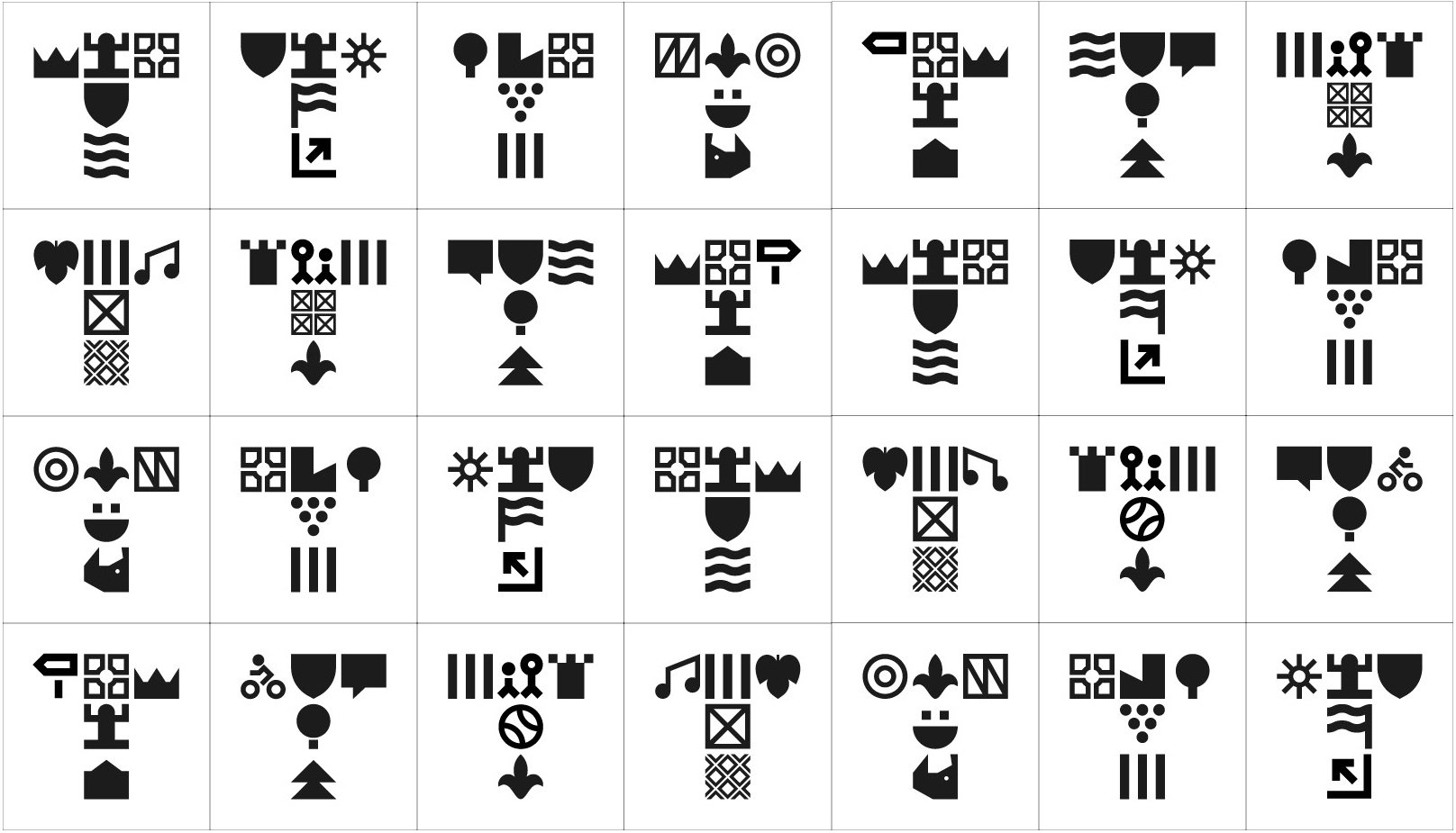
Step 1: Pictograph the territory

How can we synthesize the identity of such a rich territory, such diverse missions, without being simplistic?
We propose to create a visual language resulting from a formal analysis of the metropolis and its missions in order to constitute a repertoire of signs. This bookstore is meant to be exhaustive, plural and modular. It is organized according to different rules, from the darkest to the brightest, from the most abstract to the most concrete.

Setp 2 :  Tou(r)s pour un, un pour Tou(r)s !

From the library of signs, we propose to compose a "T" letterline (like Tours). Single letter, composed of the diversity of the territory. By enlarging and embellishing the first letter of a text, the monks of the Middle Ages brought character and animation to the manuscripts. Suddenly the text becomes an image, the letter becomes a sign. Today, contemporary studies have confirmed what we know empirically, these lettrins significantly increase the desire to read a text! An important argument when designing a logo.

Step 3: A plural and singular visual identity

This visual identity is constantly in motion and is intended to be generative. A logo generator could be imagined.
Available on the Métropole website, it would allow everyone to generate a logo on demand. The generative variables would be adapted to the communication context. For example, in the context of a communication of a project bringing together "economy","gastronomy" and "heritage", the logo would include the pictograms associated with these 3 themes.


Step 4 : The right resolution

Modularly designed, each pictogram represents one pixel of the logo. Therefore, depending on the context of use, the resolution of the lettrin can be adapted.

The logo

The lettrine is associated with a typographic block to constitute the logotype. The composition takes up the square structure in order to meet the functional challenges.

When Africa meets design

When Africa meets design

Making a good impression

At first glance, graphic design is rarely related to Africa. For cultural and historical reasons. The importance of the oral tradition and the recent dominance of European languages by colonialism led to the idea that African languages as a whole had no written forms or that they had been designed very recently.
We usually associate the origin of graphic design with the discovery of Gutenberg printing process back in the fifteenth century. Lacking sufficient printing and industrial structures, the printed materials were never really able to bloom in Africa. Therefore, the Roman alphabet and with it the entire Western graphics have been spread in African cities through advertising.
From Ghana's Adinkra symbols that are centuries old, to geometric decorations painted on the walls of houses by South African women… through the alphabets designed in the early twentieth century in Guinea to the patterns of wax fabrics worn in West Africa, the African continent is actually filled with writing systems and designs of its own. A new generation is emerging thanks to this graphic legacy and the impulse of Saki Mafundikwa. For the record, we took the opportunity to talk about his TED conference in our "Say Africa" playlist.

Evolve or die !

In 1997, Saki Mafundikwa puts an end to his brilliant career as a designer in New York and flies back to his native Zimbabwe to open the first graphic design school and new media of the country:  ZIVA (Zimbabwe Institute of Vigital Arts). Clearly underlined by the slogan "Evolve or die" on the school site home page, his ambition is nothing less than to initiate an "African renaissance". As he recounts in detail in his book Afrikan alphabets (check out his TED conference, on the ingenuity and elegance of the ancient African characters), the African continent is full of alphabetical scripts, syllabic hieroglyphics, ideograms, either very old or newer.
We know better where we go when we know where we come from. It is probably with this saying in mind that the Zimbabwean designer crossed Africa from East to West, in search of those records. He followed the footsteps of the African diaspora beyond the Atlantic, to Cuba and South America. Some alphabets he transcribed are very old, such as the Tifinagh of the Tuareg people.
Above: Afrikan alphabets book cover - Graphic design of the music album "Proud to be afrikan" by Saki Mafundikwa.
Above: ZIVA School's website home page. The school was founded by Saki Mafundikwa.
To learn more about Saki Mafundikwa and his practice of typography, check out his interview on Another Africa.
Here's a chosen extract:
"I see Afrikan alphabets offering a breath of fresh air that can rescue the Roman alphabet from the vagaries of style and trends. As a typographer, and more importantly as a designer, I am in the business of the creation and peddling of 'Beauty'. [...] Afrikan alphabets offer a more aesthetically pleasing perspective and alternative. The deconstructionists could care less about 'legibility' instead they care more about the “expressive” nature of typography. Afrikan alphabets straddle those two extremes comfortably."
And here are some examples of alphabets transcribed by Saki Mafundikwa in his book Afrikan alphabets:

T for Tuaregs and Tifinagh

Tifinagh is an ancient form of Berber script used by the Tuareg from Algeria and Libya, to write the Tamashek language. Originally composed of consonants only, vowels were lately added. Written words follow each others without spaces in-between, and can be read either vertically or horizontally. Their geometric outline allows them to be set in stone or secretly drawn in a hand palm. From one region to another, the Tifinagh characters are slightly different, each group using specific characters. The text below was written by Aboubacar Allal, a goldsmith Tuareg from Niger that Mafundikwa met in New York.
For a deeper approach, the French typographer Pierre Di Sciullo designed between 1995 and 2003 four fonts that allow to transcribe Tifinagh: the Amanar.

The Bambara alphabet

The Bambara alphabet was transcribed by Woyo Couloubay around 1930. This language is spoken by more than 3 million people in Burkina Faso, Ivory Coast, Gambia, Guinea, Mali, Mauritania and Senegal.

Nsibidi alphabet (South Nigeria)

Dating back from the eighteenth century, the Nsibidi script was originally invented by Ejagham people from south Nigeria. This language has been developed prior to the "Ekpe men" or "Leopard" secret societies. The signs are engraved on objects or painted on clothing using the bogolan technique (dyeing technique based on a decoction of birch leaves, mpécou bark, fermented mud and a mixture of soap and chlorine).

Syllabic Loma alphabet

This alphabet, meant to be read from left to right, was created in the 30s by Wido Zobo Liberia.

Vaï alphabet 

Listed in 1820 by Dualu Bukele, it is based on signs used by the elderly added to different pictograms used in certain rituals. The Vaï alphabet comes from Liberia and Sierra Leone regions. It contains 190 phonemes (a phoneme is the smallest sound unit of a language spoken). On a side note, transcripts of the Bible and the Koran into Vaï have allowed the diffusion / assimilation of new monotheistic religions throughout Liberia, that are today practiced by around 105 000 Vaï people.

Bantu / Ndélélé alphabet

The pictorial writing system of the Ndebele is quite similar to the Bantu alphabet, and come from Southern AfricaNdelélé women are known to use this system to skillfully decorate their house walls, mixing highly colorful symbols and geometric patterns. Their houses and by extension their culture, is now classified cultural heritage by UNESCO.
Recently these patterns have been declined on all types of contemporary objects or have been used as graphical object to create visual identities. Below, examples of this positive" diversion" as a transfer of images from the past on media of the future...
Above: Designers inspired by these signs and using them to decorate the British Airways air fleet, a Ndélé house, or the Ll BMW 525i by Esther Malhangu in 1991 which was exhibited at the New York Museum of Arts and Design in 2003.
These non-profit objects reflect a willingness to adapt symbols assigned to a specific culture into a kind of graphic quote for new contemporary media.
Above: Creation of the visual identity for beauty products line by Cécile Johanet : "I wanted to graphically dig this track and I proposed a young entrepreneur who makes natural cosmetics for Afro hair and skins to integrate these symbols in the visual identity of the brand."

Adinkra alphabet (Western Africa)

Some Adinkra ideograms were discovered engraved on tiny gold weight used by the Ashanti, long before colonization, making it difficult to put a date on their origins.
Still used today, these signs are associated with proverbs, sayings, recommendations, which constitute the cornerstone of the Ashanti culture. These can be: advice on education, sustainability (how to use the long-term natural resources), politics with the definition of democracy or the sharing of wealth. Symbols are classified according to their graphic meanings.
In Ghana, Vodafone borrows local traditional signs by decorating sim cards and shops using Adinkra symbols.
Facebook post from Vodafone Ghana, inviting locals to answer a quizz on Adinkras. Doesn't this symbol remind you of the Carrefour logo ?
Today, African designers readapt these symbols to create local business logos. Conversely, international firms use these cultural landmarks as decorative trim on their products to meet the local market. This usurpation of traditional symbols by multinationals engages some rising resistance from local people ...
In big cities and small villages in Ghana, some companies allow themselves to use the walls of private homes and community spaces for their own advertising. In many cases, they vaguely promise of small amount of money or free mobile phones to the families.
The public space, once belonging to communities and families, is now privatized with logos that significantly alter the urban landscape.

Re-Painting the Red

Charlie Michael took action in this context. He stamped once again over a home facade with a series of Adinkra symbols in an arrangement that imitates the Vodafone logo. This subversive act claims ownership of private space by the inhabitants.

Re-Painting the Red, from the Curio Kiosk project during the Kumasi Symposium, Kwame Nkrumah University of Science and Technology. Kumasi, Ghana, July 2009.
Below: Logotypes of three Ghanaian banks inspired from Adinkra symbols.
Direct diaspora (Africans living outside Africa) and indirect (several generations descendants) were the first to use Adrinka ideograms in their communication.
Today Adrinka, Bantoun, Ndélélé and other acronyms are considered as "African pictograms." Since 2010 the website thenounproject.com collects and compiles visual communication symbols just as an image bank. Many graphic designers from various countries play a part in this project. 
Above: The effigy of Jacques Chirac on a wax cotton shirt. Personal collection from Bonjour Bintou

Wax is the new black

It's impossible to speak about African graphic design without mentioning wax cotton. This alternative visual language is very popular on the continent. It offers a variety of patterns printed with wax technique on fabric measured in loincloth (1 loincloth = 1 yard of fabric).
Originally designed and produced in Indonesia, wax cotton was brought over by the renowned Dutch company Vlisco in the XXth century. These loincloth rapidly got close to the heart of African women, thus making its distribution easier throughout the continent. Fast enough, patterns evolved with African habits and customs, narrating History, political life, social relations, saying etc...
It's almost impossible to guess who's behind this or that design. However, experts can usually shed light on their meaning when needed. These patterns depict daily life objects, symbols, animals or even leading figures such as singers, religious icons (Jesus, Maria, priests, saints) or presidents (François Mitterrand, Jacques Chirac, Nicolas Sarkozy and François Hollande have their own wax cotton pattern).
Each region has a meaning of its own; this symbol or animal can illustrate a saying in a country but a quality in another. Vlisco invites wax cotton connoisseurs on their participative website to unveil the meaning and stories of deep buried symbols with uncertain origins.
For a long time, Beninese and Togolese women sold wax loincloth on the market. Taking advantage of the growing craze for wax cotton, some of them made a fortune and were able to show off in Mercedes, earning the nickname « mama benz ».
Above: 1/ Roller skates. 2/ Pattern inspired by an advertisement for Korean Airlines, in which the outline of a plane stands out from the sky and tree branches bloom over the moon. 3/ Pompi togo. 4/ Obama tree. 5/ Myriam Makeba, south-african singer. 6/ The head of family holding a baby and a young boy in his arms, siblings at his feet (3 girls in red coats, the eldest boy standing on the left). 7/ Detail of a Korean Airlines loincloth: the swallows symbolize luck, and the pattern alternatively means in Togo 'asking a favor', such as a young woman's hand. This pattern is also known as "Air Afrique" because it was used for the uniforms of Air Afrique air hostesses. 8/ Buses.
Wax cotton is used to create everyday and special occasion clothes. Some people, mainly the young ones, usually go for international/occidental clothing (jeans, T-shirts) but when comes a special occasion they certainly put on they wax garment. For wedding or funerals, the inviting family chooses the leading pattern design which will be used. The guests are then expected to use these wax designs on their specially crafted outfits.
Dressmakers demonstrate great skills in making dresses, suits, tunics, suits, trousers, etc. It must be for this reason that one can find a couturier on each street corner in Western Africa!
Nowadays, wax is starting to gain more and more of non-African designers' attention. Patterns on furniture, leather goods, shoes, jewels and everyday life objets (cars, phone cases etc) are becoming increasingly frequent.
Above: "So wax Chateau Rouge" collection from Merci.
Above: As a nod to wax, 'Les couleurs du Pont de Flandres' association painted a large fresco with wax patterns in Cambrai street, in district 19, Paris. This wall painting was created to celebrate the opening of the new RER station; Rosa Parks.
Below: Panafrica shoes, a french brand committed to Fair Trade which uses wax as main material.
Through their meanings, with their colors and designs, these wax patterns are extremely rich. All the more so as they constantly evolve, encompassing elements of contemporary African daily life. Cellphones, fans and computers have already been part of wax design for a decade.

Afropolis

One year ago, the Vitra Design Museum dedicated a profuse exhibition on contemporary design techniques in Africa: Making Africa – A continent of Contemporary Design. In this daring exhibition, artists, designers, researchers and intellectuals illustrated that Africa is once again a land of innovation.
In 2050, a quarter of the population will live in Africa. It's the most dynamic region in the world in terms of growth and mobile phones market. Not so long ago Africa had a limited access to technology. Nowadays, the digital revolution is an open door to the continent.
This exhibition helped to take a fresh look at contemporary design in Africa. Far from being solely limited to handcrafting productions for exotic purposes, Africa now stands as an experimental land of new approaches and solutions spread worldwide.
Above: Some artworks showcased at the Vitra Design Museum.
Pierre Christophe Gam is an ambassador of this new generation. Considered as the designer of the "African renaissance", he graciously combines many roots : Egypto-Chadian on his mother's side, an African art collector, and Franco-Cameroonian on his father's side, a diplomat. 
To embody this new Africa, Pierre-Christophe Gam finds his inspiration from his designer/set-designer experience in the luxury industry in London, Beijing or Bangkok, for Kenzo, Maison Martin Margiela, or the design agency Emotion (a Publicis subsidiary). Graduated from Central Saint Martins School (the famous Arts and Design London-based school), his inspiration comes from his journeys in Asia where he discovered manga art and more broadly the effusive oriental artistic contemporary scene.
In 2002 he renewed with his roots during a 7 months old travel, ending up in Cameroun, his ancestors' land. Thirty years old at that time, the young man started an artistic project which still continues to this day: Afropolis, an "Afropolitan" virtual city, symbol of the renewal of a continent where contemporary artistic creation blossoms without restraints. From fashion to music clips, aesthetic codes combine African-Asian cultures in bright graphic references.

There is not enough Africa in computers

While writing this article a famous quote of Brian Eno comes to my mind, « There is not enough Africa in computers ». He stated so in an interview for Wired in 1995, when asked to share his view on the future of electro music.
"Do you know what I hate about computers? The problem with computers is that there is not enough Africa in them. This is why I can’t use them for very long. Do you know what a nerd is? A nerd is a human being without enough Africa in him or her. I know this sounds sort of inversely racist to say, but I think the African connection is so important. You know why music was the center of our lives for such a long time? Because it was a way of allowing Africa in. In 50 years, it might not be Africa; it might be Brazil. But I want so desperately for that sensibility to flood into these other areas, like computers."
Above: Nigerian born artist Laolu Senbanjo takes his inspiration from Yoruba tribal art.

The end of exoticism?

Once fashion trend or marketing strategy, it seems that African influence is back. It would be valuable that we, European designers, start considering African creation out of the exotic prism. Nowadays, with the rise of the digital craze, things are starting to change. Young people start to have more and more interest for graphic design and end up developing their own peculiar style.
This new generation gives birth to symbols, patterns... a whole traditional graphic culture. This new creativity deserves our greatest respect, and we welcome this new inspiring approach.
Above: Dicky Jr is a multimedia designer from Nairobi, Kenya. His Adobe Creative Suite splash screens are inspired from african patterns.

Black is beautiful

To conclude this article, we most welcome the editorial initiative of the Danish design studio Waait which created the magazine "Ogojiii". This project grew out of two ideas combined together: cutting edge design innovation comes from Africa, and all design styles are crucial to create a brighter future.
Ogojiii brings together African communities from fashion, architecture, crafts and digital design backgrounds together in a web acting as a catalyst for entrepreneurship innovation dynamics. Ogojiii aims at revealing a new African élite wanting to enhance design perspectives as a lever for action for companies and industry.
To put the icing on the cake, this magazine is splendid on both form and substance. Sadly, it is quite hard to find in newsstands.
If, like me, you've had a crush on this magazine, I'd recommend you to buy it directly online.
You can learn more on this editorial project, and about the origin of its mysterious name in the video below:

The Black Experience in Graphic Design

The Black Experience in Graphic Design

By Dorothy Jackson
Five talented black designers candidly discuss the frustrations and opportunities in a field where “flesh-colored” means pink
black designers graphic design history cover
Cover of Print XXII:VI 1968
The graphics industry is constantly seeking fresh talent. Where does the black  designer fit into this search? In a field where talent is the prime prerequisite, are black designers’ abilities being sought and developed?
The fact is, of course, that there are still just a relatively few black designers in the field. Perhaps this is due to poor quality of training, lack of perseverance (some just give up), discrimination, frustration, or lack of opportunity. The black designers whose opinions are presented here feel it is a combination of these factors, and more.
Yet the very existence of even these few designers would indicate that it is possible for young black people to receive adequate training in the design profession, even though the subsequent route to satisfactory employment may be circuitous, frustrating and sometimes stifling to a budding creative talent. Bill Howell, for example, remembers that he had to secure his first job via the intervention of the N.A.A.C.P. William Wacasey, faced some time ago with segregation in southern schools, studied art and advertising by means of correspondence courses; after graduating from high school, he went on to art school in Chicago and Detroit. Dorothy Hayes says, “I do not think that I have ever experienced so much discouragement and suppression of black artists in art instructors treat the black student as though he were some out-and-out freak and a tremendous threat to the instructor, when all the student is trying to do is develop talent.”
However talented he may be, the job-seeking black designer still runs into such embarrassing, if not humiliating, situations as being asked to do “brain-picking” homework, or, as Wacasey recalls, arriving to keep an appointment with an art direction and “having the receptionist hand me a package because she thought I was a delivery boy.”
To counter the effect of such situations, Alex Walker (one of the few black studio owner-operators in New York) ruefully advises the design school hopeful who is about to “offer him or herself to the graphic arts would to do so with the eyes wide open, plenty of Excedrin and a degree in another field—just in case.” Many black graphic arts students do, in fact, minor in education while getting their BA, and after long, fruitless periods of seeking design work that suits them, eventually give up and go into teaching.
black designers graphic design history Bill Howell
Bill Howell
black designers graphic design history Alex Walker
Alex Walker
But this is by no means always the case. Bill Howell is among those who persisted in the field, with no intention of giving up. His first job when he go out of art school required him to do the usual apprentice work—mechinalcs and flapping and labeling finished art—a job which gave him useful experience in the basics of advertising design. Also, in delivering jobs to clients, he was afforded valuable exposure to the field.
Two years elapsed before Alex Walker found his first design job, after attending Pratt Institute at night. To fill the void, he became a freelance silkscreen film cutter. When that elusive first job did come, it was with a studio.
The gap between the black designer’s first job and his first creative position is considerable. Dorothy Hayes relates that “I was employed by a well-known broadcasting company and led to believe that I would hold a design position, yet I was never allowed to do anything but non-creative work. I was frankly told that my employment was simply a form of tokenism.”
Tokenism is still the order of the day in the graphic arts industry (having replaced a routine refusal or a smiling “I’ll call you”). However, there are signs that conditions are changing: advertising agencies in particular show a greater willingness to open up their bullpens to more black designers.
black designers graphic design history poster for pamoja gallery
Poster for Pamoja Gallery designed by Bill Howell
There are certainly many more black art directors in agencies now than there were five or ten years ago. Then, there were so few that their numbers were statistically insignificant. Today, black designers constitute perhaps one or two per cent of the total—not exactly an overwhelming percentage. In an advertising agency employing approximately 40 art directors, one can expect that about one to three will be black. However, in an agency employing 200-300 art directors, you will usually find the same one to three who are black. Also, the salary of the black art director is far less ($2000 to $5000 less) than that of a white art director at the same level.
Futhermore, as Bill Howell points out, “The majority of black people who work as designers at advertising agencies never get to see the white clients. A black art director friend of mine had been working on a particular account for some time, but the client didn’t know he was black because all transactions had been conducted by telephone. When he appeared in person one day to revise a mechanical, the representatives of the company were genuinely shocked.”
With his sights set on on accumulating enough experience to ready himself for the hoped-for art director’s job, the black designer often sidetracks into freelance work; a few black designers in New York have sidetracked prematurely, opening up their own design studios. This was the case with William Wacasey. who worked his way through the usual channels of lettering and display man for retail outlets and packaging/product designer for an industrial design firm before opening Wacasey Associates—New York’s first black-owned design studio—only to discover initially that “because I was black I tended to get the smaller jobs or those with practically no budget.”black designers graphic design history symbol for island record
black designers graphic design history symbol sketch for PE
Top: Symbol for Island Record Co. Designed by Alex Walker; Bottom: Symbol sketch for Product Engineering magazine (unused)
Alex Walker opened his own design studio last year, after leaving a position with a studio which he had help for 13 years. This long stay with one firm is not unusual; when a black designer gets a job in the design field, he tends to keep it, knowing there is not an over-abundance of positions available to him. Looking back on his own experience, Walker states, “Unusually long periods of employment at one job tend to hamper one’s creative process. Most white designers who eventually become award-winning art directors or make lots of money spent short periods of time in various studios and agencies. With each move, their knowledge, contacts, and usually their income increased. This is one modus operandi that has left the black designer in the dust.” One reason black designers don’t move around more is that they lack the all-important contacts in the field through whom job openings are referred. In his anxiety simply to get any work in the field, a black designer may get tied down to a department store or supermarket advertising department. Stuck in this backwater, he never gets to meet people in the mainstream and thus is unable to find out what is expected of a designer in a large-agency art department.
black designers graphic design history Dorothy Hayes
Dorothy Hayes
black designers graphic design history Dorothy Akubuiro
Dorothy Akubuiro
Dorothy Hayes raises an interesting—if painful—point. “When I came to New York ten years ago I couldn’t find anybody black in the commercial art field. Finally, after I found a job on my own, I did start toencounter black people. But in the course of trying to develop my talent I found that if I went to them for some direction, they just wouldn’t give it. Nobody wanted to take the time to show or tell me anything. I vowed then that if I made it I would never turn my back on any black person who came to me for advice and information and who really wanted to learn.” GAP (Group for Advertising Progress), a recently formed black organization, has been trying to alleviate this very problem by pooling members’ contacts in the advertising field and making the information at their disposal generally available to blacks. While GAP does not see its function as that of an employment agency, it has been successful in locating positions for several black art directors.
Dorothy Akubuiro, who now has a satisfying position in the art department of R. R. Bowker Company, states, “If I were to relate my earlier experience, it would probably reflect great bitterness—the bitterness being a result of three quite restricted years in the field . . . of being unable to do what I really wanted to do—creative work.” The job at Bowker, says Miss Akubuiro, “has been one of the most wonderful experiences of my life. I’m given quite a lot of freedom in my designing, as well as the opportunity to pursue my special interest, which is photography.”
Some black designers—Miss Hayes and Bill Howell among them—have never made a major swerve from a path that will directly prepare them for the job goal of art director. Both have held a variety of positions in which they were able to gain broad experience in all aspects of graphic design—in addition to doing a good bit of freelance work. At the same time, both strongly feel that the black designer should not be denied his blackness in order to operate successfully in the design world.
black designers graphic design history Type Talks cover designed by Dorothy Hayes
Type Talks cover designed by Dorothy Hayes
Black people are an integral part of the American social and economic scene—on all levels. They read Harper’s Bazaar as well as Ebony; they shop on Fifth Avenue as well as 125th Street; they buy the same furniture and groceries and lingerie and toothpaste as whites, to the tune of $4.32 billion per year. Despite this, Hayes and Howell contend, the advertising industry is geared almost exclusively to white attitudes and standards, white concepts of beauty, white modes of fashion. “Black mannequins and models and flesh-colored skin tones in shades of brown instead of shades of pink are rarely seen in an ad campaign,” Howell points out, “unless it is for a predominately black market—or when the ad relates to jazz or other ‘ black’ music.” Adds Miss Hayes: “Black male models are seldom used in TV commercials; female models are used somewhat more frequently. When black models are seen, it is usually fora split second only. The angle is often blurred, the composition unflattering.”
Black designers, Hayes and Howell feel, must push for a positive view of blacks in advertising, as well as for their appearance in advertising in proportion to their buying power.
But for black designers to exert this kind of influence requires that there be more of them in the field.
Whether or not their numbers do increase is, to some extent, up to those black designers who are already established black designers would seem to have a substantial stake in seeking out and encouraging these young people—guiding them when possible to situations where they can gain experience and exposure.
This can only be accomplished through direct, personal involvement—involvement such as Alex Walker’s participation in Ogilvy & Mather’s program for training minority youth interested in entering the advertising field. In this program the novice serves a six-month apprenticeship in Walker Studios, then goes into the agency as an assistant art director.
black designers graphic design history William Wacasey
William Wacasey
Regrettably, involvement of this kind by established black art directors in agencies occurs infrequently. In fact, young black freelancers trying to get a foothold in the field often find themselves hindered by the noncommittal, indifferent attitudes of black art directors and account executives who, though in a position to give them work, do not. (Since opening his studio, Walker reports, he has received but one referral to a national account by a black agency executive.)
Aside from their Madison Avenue involvements, a number of talented black designers are directing their creative energies toward the black community itself, in an effort to communicate the black ethnic heritage as a specific cultural entity. One such designer is Bill Howell, who has found the experience to be enormously rewarding in that it provides him the opportunity for total design freedom, and also “permits me to meet some great people.” Howell recently joined WEUSI (which means “blackness” in Swahili), an organization of black artists in Harlem. The group, which in 1963 mounted Harlem’s first outdoor art exhibit, is now working to gather and exhibit ethnic art in the community.
In assessing the black designer’s chances for achieving a satisfying career in the graphic design field, one must state that his chances are considerably better today than they were a few years ago. Every time a black designer gets a good creative job, his presence and talent serves to open the field further for other blacks—provided the established designer is willing to share his experience with talented but uninformed black youth, as well as with black designers on their way up (as we have seen, this willingness to share to share is not always forthcoming).

Graphic Design in South Africa: A Post-Colonial Perspective

Abstract

This article offers a broad historical overview of the development of graphic design in South Africa and an analysis of a sample of recent South African graphic design informed by post-colonial theory, imperial studies and settler colonialism theory.

The historical overview indicates how closely the development of graphic design in South Africa was implicated in settler colonialism in particular. Yet, graphic design in South Africa was also used to resist colonialism and following the 1994 democratic election there was optimism about its role in South Africa’s transformation.

However, numerous challenges faced post-apartheid graphic design and to assess how it responded to these challenges this article analyses a number of categories of the 2013 Loerie Awards, which position themselves as the authority with regards to determining standards of excellence in brand communication in the region. In interrogating the representation in and the discourse created by the award-winning work the article concludes that graphic design in South Africa, as represented in this award scheme, does not reflect a substantial engagement with post-apartheid transformation challenges, which include the elimination of stereotypes, establishing gender equality and grappling with language and culture issues. Instead, the award scheme perpetuates narratives steeped in colonial and imperialist discourses.

5 African artists influenced by history

Zimbabwean designer Saki Mafundikwa has a powerful vision for the future of African art. As the founder of the Zimbabwe Institute of Vigital Arts (ZIWA), Mafundikwa is working to bring African art back to its roots. ZIWA, the first school of graphic design in Zimbabwe, and one of the first schools to emphasize the use of digital technology to teach the visual arts, places the continent’s rich artistic history at the center of its curriculum.
Saki Mafundikwa: Ingenuity and elegance in ancient African alphabets 
Saki Mafundikwa: Ingenuity and elegance in ancient African alphabets This idea sits at the heart of today’s talk, in which Mafundikwa encourages African artists  to take a look at their own cultural heritage for artistic inspiration, rather than looking to the outside world.  He sums up the concept with the Ghanaian glyph Sankofa, which means literally “return and get it” — or “learn from the past.” Says Mafundikwa, “We must go to the past so as to inform our present and build on a future.”

In his talk, Saki Mafundikwa celebrates Africa’s creative heritage by surveying the continent’s history of written language. Jumping across nations, Mafundikwa describes the fascinating writing systems of societies from the Akan to the Bantu to the Yoruba. He points out that, contrary to popular belief, African writing may date back hundreds of years earlier than the scripts of Mesopotamia.

In the spirit of Mafundikwa’s call to action, here is a look at a few African artists who are incorporating their heritage and traditions into their work. These artists offer diverse perspectives, putting Mafundikwa’s ideas into conversation as they contest and corroborate them.
Born to Sudanese and Egyptian parents, artist Fathi Hassan explores his Nubian heritage through the written word. He imagines scripts inspired by his ancestors’ calligraphy, creating beautiful but illegible text. In doing so, he emphasizes the language loss that occurred under imperial domination and recalls his upbringing in a primarily verbal, illiterate society. Hassan was the first artist to represent Africa in the emerging artists category of the Venice Biennale. [Fathi Hassan]

Nigerian printmaker Bruce Onobrakpeya also places the alphabet at the center of his work. He invented the Ibiebe script, a fusion of Chinese and Japanese calligraphy with the writing found in the Urhobo groups of Southern Nigeria. Onobrakpeya was educated by the Zaria Rebels, a school of Nigerian artists who emphasized the decolonization of African art from Western influences. His art received an honorable mention at the Venice Biennale, and he was honored with UNESCO’s Living Human Treasure Award in 2006. [Wikipedia]

Beyond the scope of the aestheticized written word, cultural heritage manifests itself in different ways in different mediums. Ladysmith Black Mambazo, the acclaimed male choral group from South Africa, celebrates its Zulu heritage by keeping isicathamiya and mbube singing styles alive. Half a century and three Grammys later, the group has evolved to create the Ladysmith Black Mambazo Foundation, which opened in 1999 to teach children of Zulu heritage about traditional isicathamiya music. [Mambazo]

“Histology of the Different Classes of Uterine Tumors” by Wangechi Mutu. Source: Flickr/Cea
Nairobi-born painter and sculptor Wangechi Mutu explores the landscape of post-imperial Africa in the face of globalization. She blends the aesthetics of traditional African art with images of the female body, giving her work a feminist and African feel. Blending the modern and the traditional, “her works document the contemporary myth-making of endangered cultural heritage.” Mutu’s work has been displayed at the MoMA, the Tate Modern and the Pompidou Center, among others.  [Saatchi Gallery]

Bonus:
British-Nigerian sculptor Yinka Shonibare offers an opposing artistic vision. Counter to Saki Mafundikwa’s desire for African artists to return to their roots, Shonibare blurs the lines of social categories as he explores his transnational heritage.  Shonibare emphasizes the hybridity of his identity as he incorporates vivid African-style textiles with Victorian attire to create a fusion of cultural crossbreeds. 

He considers culture to be an artificial construct, and in incorporating the different facets of his own identity, he aims to stretch and erase preconceived notions of social groups. His work focuses on individuality, rejecting traditional groups in favor of modern fluidity. Shonibare’s work has been exhibited at the Venice Biennale, and he won the Turner Prize in 2004